

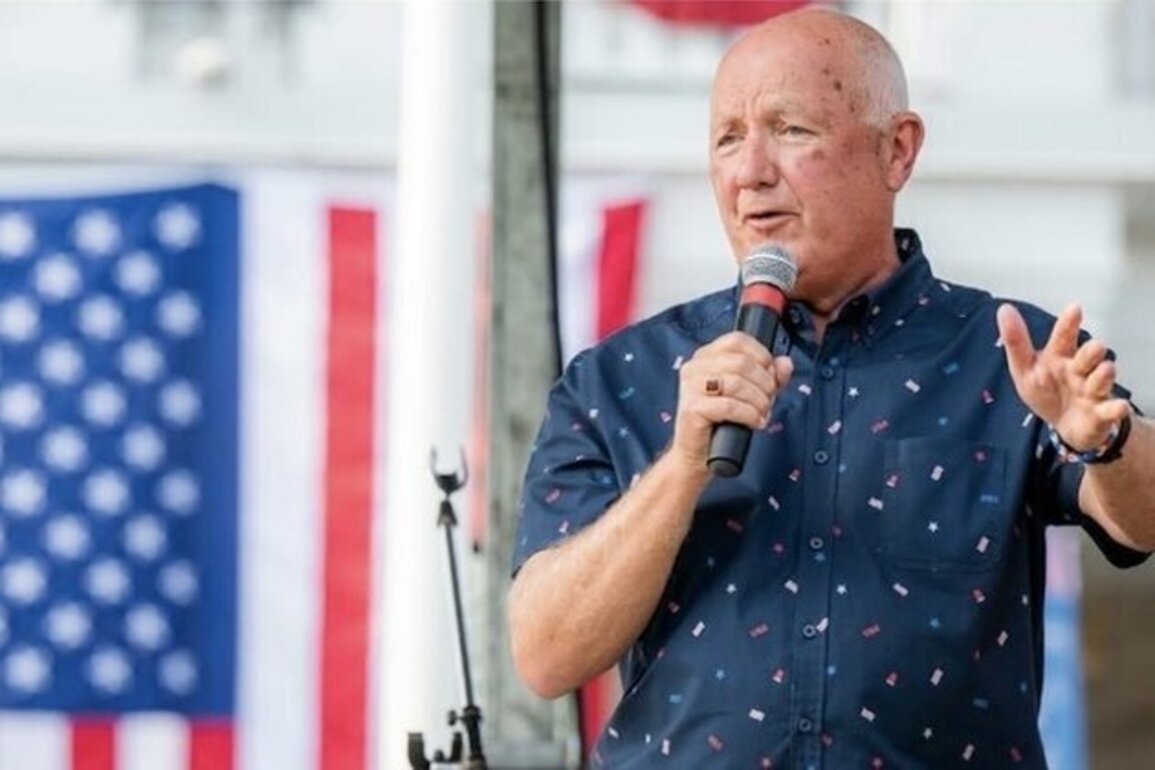
U.S. Ambassador to Canada Pete Hoekstra said Tuesday that the summer's latest wildfires offer a "stark reminder" of the countries' shared challenges, just a day before a second group of Republican politicians filed an official complaint about cross-border wildfire smoke and demanded an investigation into Canada's fire management practices.
In a statement shared by the U.S. Embassy, Hoekstra said the fires show the importance of the two countries working together, The Canadian Press reports. He said he's "proud" of the more than 800 U.S. firefighters who are helping Canada during the wildfire season, a mobilization that includes air tankers, firefighting crews, incident management teams, and overhead staff.
"The wildfires raging across Canada, from Vancouver Island to Newfoundland, are causing immense hardship and have forced families to evacuate their homes and communities," Hoekstra said in the embassy statement.
"Poor air quality here in Ottawa, across Canada, and in the United States caused by the wildfires is a stark reminder of the shared challenges we face and the importance of working together to protect lives, communities, and natural resources."
Hoekstra acknowledged the United States and Canada have "a long history" of supporting one another in times of crisis. "Canadians stood with us during the tragic California wildfires earlier this year, and we are committed to standing with Canada now," he said.
But in a Wednesday news release, Wisconsin state Rep. Calvin Callahan joined other Republican state lawmakers from Iowa, Minnesota, and North Dakota in filing a formal complaint against Canada to U.S. Environmental Protection Agency Administrator Lee Zeldin, last seen trashing the 2009 endangerment finding that is the cornerstone of U.S. climate law, as well as the International Joint Commission (IJC), a binational organization that resolves disputes on shared water and air quality.
The Republican lawmakers called for an investigation of Canada's wildfire management practices and for potential remedies under international law, CP writes.
"If Canada can't get these wildfires under control, they need to face real consequences," Callahan said in his release. "We won't sit back while our air becomes a health hazard."
Callahan joins a chorus of Republican politicians at other levels of government who have been complaining about Canada's wildfires.
Michigan Rep. Jack Bergman sent a letter to Canadian Sen. Michael MacDonald on Monday calling for stronger forest management policies and more accountability from Canadian officials. Both are members of the Canada-United States Inter-Parliamentary Group.
Separately, Michigan Rep. John James sent a letter to Prime Minister Mark Carney last week saying his constituents are choking on toxic wildfire smoke. He claimed Manitoba Premier Wab Kinew's declaration of a second state of emergency in his province "confirmed what many Americans have feared: that Canada is not doing nearly enough to stop these fires before they start."
Despite Hoekstra's soothing words Tuesday, it was a different story just days earlier, when the often outspoken ambassador commented on what it would take to boost cross-border travel with next year's FIFA World Cup on its way to Vancouver and Seattle.
"Canadians staying home, that's their business, you know. I don't like it, but if that's what they want to do, it's fine. They want to ban American alcohol. That's fine," he said. But "there are reasons why the president and some of his team referred to Canada as being mean and nasty to deal with, OK, because of some of those steps."
The flurry of wildfire letters from Trump's legislative allies began in mid-July, when six Republican members of the House of Representatives wrote to Canadian ambassador Kirsten Hillman with a demand for action. Reps. Tom Tiffany, Brad Finstad, Tom Emmer, Michelle Fischbach, Glenn Grothman, and Pete Stauber of Wisconsin and Minnesota said their constituents were coping with suffocating smoke billowing across the international border into their states, CP reported at the time.
"As we are entering the height of the fire season, we would like to know how your government plans on mitigating wildfires and the smoke that makes its way south," the letter said.
"I seem to recall when LA was burning, Canada sent water bombers, not bullshit," retorted one commenter on Threads.
"We'll keep our smoke, when you keep your CO2," another poster suggested as Canada's official response.
"Sorry for ruining your summer," added a third. "I'm sure all the people who have lost everything in these fires feel really bad for you and will send letters of apology."
After the latest round of letters to Zeldin and the IJC, Kinew accused Callahan and his colleagues of throwing a "timber tantrum" and playing "political games" with their complaint.
"These are attention-seekers who can't come up with a good idea on health care or on making life more affordable [and certainly not on the climate emergency that is making the fires more frequent and severe-Ed.]," Kinew told CP. "So they're playing games with something that's very serious."
Kinew stressed that he doesn't "generalize these attention-seekers' misguided words to all Americans." He noted that American firefighters have been helping to fight Canada's wildfires and Canadian firefighters were on the ground and in the air during California's devastating wildfire season.
"I've thanked them and I thanked folks in the Trump administration who sent some of the federal firefighting resources up to Canada and to Manitoba," the premier said. "So we're going to have a continued relationship and an ability to support each other through wildfires going forward."
In the original complain last month, the six House members said successive years of wildfires in Canada have undermined air quality in their states and robbed Americans of their ability to enjoy the summer, CP reported at the time. They repeated cascading disinformation about poor forest management and arson to suggest possible factors behind the fires. They did not mention climate change.
Nor did they acknowledge publicly available research identifying the share of wildfire activity in parts of Canada and the U.S. that can be attributed to oil and gas extraction by U.S.-owned fossil companies-precisely the kind of activity Trump is trying to encourage with his increasingly futile "Drill, Baby, Drill" agenda.
The CP coverage made no reference to the six politicians' voting records on climate issues. But as House Republicans, they all would have supported recent Trump legislation that dismantled Biden-era clean energy laws and climate initiatives.
By the time the latest round of "timber tantrums" emerged, the cross-border wildfire conversation was already heating up online, after a post on Threads last weekend amplified the U.S. lawmakers' factually challenged demands. Here are some greatest hits:
@Judy Kavanagh: Social media is full of Americans like this one complaining about wildfire smoke coming from Canada (even though there are more fires in the U.S. than Canada). Canadians, of course, respond with humour.
@risealderink: Canada, please stop poisoning our air. I haven't been able to go outside all week. The AQI has been 150+ and it's the second worst in the world right now. You're literally killing us.
@johnnynovak: Whose turn is it today to work the smoke machine pointed at the U.S.?
@bsurgeoner: It was my turn but I had to take my moose to the vet. Maybe someone can switch with me?
@s94741h: My collective golf foursome pulled an overnight shift at the "Only for American Export" fentanyl factory, so can we get a later shift today?
@suelarcheveque: I'm on the sched for tomorrow at 5am, I prefer the early shift gets the smoke going before they get out of bed, ruins their entire day.
@kathymcc: Just got off my shift with the giant faucet here in B.C. I'll head on over to the island smoke machine now. Elbows up.
The Canadian Interagency Forest Fire Centre, a non-profit owned and operated by federal, provincial, and territorial wildland fire management agencies, says on its website that almost 750 active wildfires are burning across Canada, CP writes.
Thousands fled from a First Nation in northern Manitoba days ago as wildfires approached the community. The Nisichawayasihk Cree Nation near Nelson House issued a full evacuation order Sunday as the flames threatened to cut off road access.
The number of wildfires burning in British Columbia has more than doubled in the past week after a stretch of hot, dry weather and thunderstorms that produced more than 67,000 lightning strikes. Light rain and high humidity brought a reprieve earlier this week, CP wrote, but the provincial firefighting service was predicting tough days ahead.
Multiple wildfires are also burning in Newfoundland, prompting evacuation orders and destroying structures in a community in the eastern part of the province.
And air quality warnings extended through much of Saskatchewan, most of Manitoba, and into northwestern Ontario, while Toronto and surrounding cities faced the fifth days of wildfire smoke on Wednesday.
Major segments of this story were first published by The Canadian Press on August 5, 2025.
Source: The Energy Mix