

Prime Minister Mark Carney has agreed to sharply reduce tariffs on electric vehicle imports from China, while China offers up tariff relief for Canadian canola, peas, pork, and seafood, prompting Canadian observers to predict lower EV prices and possible long-term advantages for the country's automotive industrial base.
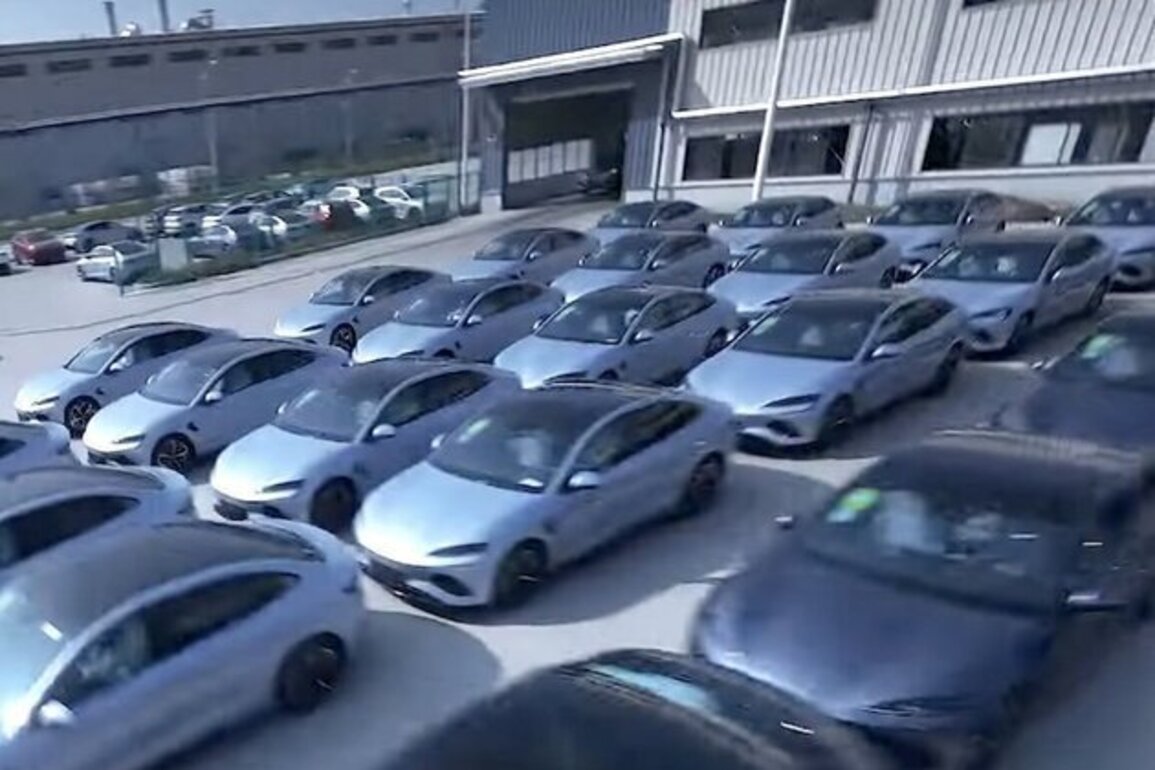
Canada will slash duties on up to 49,000 Chinese EVs per year to a "most-favoured-nation tariff rate" of 6.1%, Carney's office said in a release. The imports will amount to less than 3% of annual new vehicle sales in Canada, but "will drive considerable new Chinese joint-venture investment in Canada with trusted partners to protect and create new auto manufacturing careers for Canadian workers, and ensure a robust buildout of Canada's EV supply chain," the PMO said.
Within five years, more than half of those vehicles "will be affordable EVs with an import price of less than $35,000, creating new lower-cost options for Canadian consumers," the statement adds.
Carney later told media the annual total will rise to 70,000 vehicles per year by 2031.
In return, by March 1 China will reduce its 84% tariff on Canadian canola seed entering its $4-billion annual market to about 15%, and eliminate excess tariffs on canola meal, lobsters, crabs, and peas, through the end of this year.
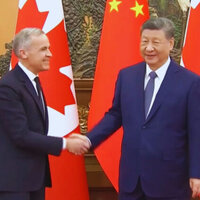
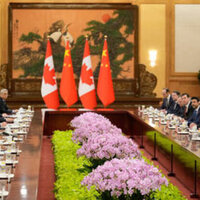
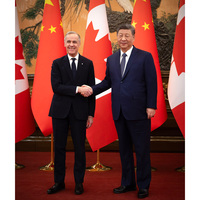
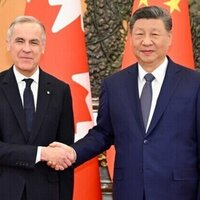
Carney and Chinese President Xi Jinping also "discussed increasing two-way investment in clean energy and technology, agri-food, wood products, and other sectors," with Canada setting 2030 as a deadline to increase exports to China by 50%. That includes non-binding agreements on oil, gas, and uranium development, finance, public security and safety, and food safety, as well as a five-year memorandum of understanding on modern wood construction between Canada, China, and British Columbia.
"Central to this new partnership is an agreement to collaborate in energy, clean technology, and climate competitiveness," the release stated. "Canada and China are both energy superpowers focused on expanding two-way energy cooperation-reducing emissions and scaling up investments in batteries, solar, wind, and energy storage."
On LinkedIn, Climate Action Network Canada Executive Director Caroline Brouillette pointed to the "very loud absence of any mention of oil and gas" in that passage, "which says a lot about the direction of the global economy" and constituted "yet another argument against the pipeline pushers' delusions."
Overall, "it's a partnership that reflects the world as it is today, with an engagement that is realistic, respectful, and interest-based," Carney told media in Beijing.
"From energy to agriculture to people-to-people ties to multilateralism, to issues on security, we believe that the spirit and the substance of these discussions, and these agreements, will provide great benefit to each of our peoples," he added earlier in the visit.
Clean Energy Canada, a B.C.-based think tank that has long advocated against the EV tariff, hailed the announcement as "a breakthrough for consumers with potential for investment in a modern auto sector," in a media release that included a detailed history and assessment of the issue.
"Canada inadvertently 'broke' its EV market with a combination of policy changes under the past two governments: ending the EV incentive, pausing the EV Availability Standard, and imposing a 100% tariff on Chinese EVs in late 2024," Executive Director Rachel Doran said in the release. But "Canada's approach to tariffs on Chinese EVs has never needed to be so binary. While we have simply followed the sledgehammer approach of the U.S. to date, the option has always been open to implement a more flexible lower tariff like our other allies did in the EU."
Canada "is in a difficult position these days," Doran told The Energy Mix in an interview. "So what we've been suggesting the government do in the changing terrain is put Canada first. The assumption that Canada is best served by borrowing Trump policies on EVs or fully endorsing the position of U.S.-based automakers may not be the best for Canadian consumers, or even for Canadian industry in the long term."
Clean Energy Canada's polling last summer found that nearly half of respondents wanted their next vehicle purchase to be electric, she added. "It's just that we haven't had the vehicles available at the price point that made sense for Canadians. So a choice, even if it's just 3% of our EV market, can make some of those more available," and "spark a bit of competition in the marketplace for Japanese or Korean automakers to bring more of their affordable models to Canada."
Corporate Knights Research Director Ralph Torrie, who previously urged the federal government not to impose the EV tariff, said the announcement was "really quite exciting," particularly if Chinese automakers can accelerate the timeline to send affordable EVs to Canada.
Even if that doesn't happen, "the door has been cracked open, and it's a good thing," Torrie told The Mix. "I think this initial tranche of vehicles will be snapped up by Canadians who've been waiting for more choice in their electric vehicle purchase decisions, and I expect these vehicles will be relatively affordable, even if they're not under the $35,000 cap."
Torrie pushed back on accusations that China has been "dumping" low-cost cars to distort and dominate the EV market in other countries.
"When you dump products, you sell them for below what it's costing you to make them," he explained. But apart from the "ridiculously low prices" that some Chinese manufacturers have come up with for their domestic market, "I don't think they're selling at a loss anywhere else in the world."
Rather, what they're doing is "throwing down the gauntlet to all the western carmakers and basically saying: If you want to compete against this new source of supply, you're going to have to match them on price." China's EVs are "well-made, high-quality cars," he added, and the small influx in the early years of the Canada-China deal "will address the fears Canadians have about these vehicles. They'll start to see them on the road, and they'll see their neighbours getting them."
But another gauntlet landed hours after the announcement, with the Canadian Labour Congress and Unifor both arguing that Carney traded away well-paying, union jobs.
"While Ottawa frames this deal as a way to diversify markets for Canadian farmers and exporters, it ultimately puts both groups at risk, offering uncertain, short-term relief for canola and select fisheries while endangering hundreds of thousands of good jobs across Canada's manufacturing and industrial sectors," the CLC said in a statement. "In the end, no sector truly wins, and workers in every industry are left more vulnerable."
"This is a self-inflicted wound to an already injured Canadian auto industry," said Unifor National President Lana Payne. "Providing a foothold to cheap Chinese EVs, backed by massive state subsidies, overproduction, and designed to expand market share through exports, puts Canadian auto jobs at risk while rewarding labour violations and unfair trade practices."
Jim Stanford, director of the Centre for Future Work, said the average price of a new car in Canada is well above the target for affordable EVs, but the Big Three Detroit automakers had a total of three electric models below the 2024 average of $56,393.
"I don't know where this obsession with the $40,000 price point comes from," Stanford wrotein an email last fall. "The vast majority of Canadian car buyers (85% or more) pay much more than that," and a higher cost for EVs "is part of the trade-off: pay more up front, save big on energy costs over the vehicle's life."
Stanford added he supported "active measures to push the industry toward faster transition to EVs. I think the companies themselves know this is going to happen. But they are now also trying to appease Trump." In response, "what we need are strong rules to both push the industry to keep moving in this direction, and strong rules to ensure that Canada gets a fair proportionate share of the resulting economic activity," rather than "picking sides" among manufacturers.
Doran said the experience in Europe has shown Chinese EVs creating incentives for other automakers to be more competitive, not displacing them. Last fall, Clean Energy Canada reported that the EU had 21 electric vehicle models selling for less than $40,000-seven from China, the rest from Japan, South Korea, and the EU itself-compared to just one in Canada.
"Having these lower model price points in an open economy is going to spur some competition and make vehicles generally more affordable," Doran said this week, with a "ripple effect" that goes beyond the initial 49,000 vehicles per year.
"We know the problem is not that that there is no Canadian who wants an EV. They want to benefit from the long-term savings, but have to be able to afford that up-front price."
News reports interpreted the Canada-China deal as a marked departure from the past few years of frosty relations between Canada and China, triggered largely by the frostier and existentially dangerous relations brought to Canada's doorstep by Donald Trump.
"The truce in a painful trade war helps lessen a major irritant in Canada-China relations as the Prime Minister seeks bigger overseas export markets and new foreign investment to offset the economic damage caused by... Donald Trump's protectionist tariffs," the Globe and Mail reports.
At the same time, it "raises the prospect that Canada may be putting itself offside of Mr. Trump's tough-on-China agenda, which the president expects allies to follow," the Globe adds. But Carney "told journalists that relations with China have recently been more predictable than those with the United States."
The flurry of announcements in Beijing "marks a de-escalation in tensions with a country the Liberal government had, in recent years, branded as a disruptive power, and is getting mixed reactions in Canada," The Canadian Press reports. "Ontario Premier Doug Ford and some auto industry groups are slamming the plan as a threat to the country's auto industry, but Saskatchewan Premier Scott Moe, who was in Beijing with Carney, was thrilled to see a deal he said will allow his province's canola exports to China to return to normal levels."
Ford said the deal gives China "a foothold in the Canadian market" that it will use at the expense of Canadian workers, the Globe writes. "The federal government is inviting a flood of cheap made-in-China electric vehicles without any real guarantee of equal or immediate investments in Canada's economy, auto sector, or supply chain."
Moe said the deal is "very good news for Canada and Saskatchewan," demonstrating "the importance of foreign trade missions and show[ing] what can be achieved when the federal and provincial governments and our export industries work together."
Greg Cherewyk, president of Pulse Canada, said tariffs effectively stopped all shipments to China and Canadian yellow peas worth about $700 million a year were being displaced by Russian products, CP adds. "It was really important that this didn't last as long as we had feared it would last, into the years. It was resolved in what really amounts to a short period," with timing that was ideal for farmers to make seeding decisions for this year's crop.
The news of the deal landed just a day after Washington Post foreign affairs columnist Fareed Zakaria wrote that the world is "adjusting to an unreliable United States". The European Union has also been working to reduce trade frictions with China, aiming to avert "a broader confrontation over electric vehicles, subsidies, and market access," he said. "Europe remains wary of China's industrial policies and political system, but the EU now views China as a necessary partner."
Trump's trade wars over the last year have also prompted the continent to sign a "sweeping trade agreement" with key Latin American countries that took a quarter-century to negotiate, and to accelerate its outreach in Southeast Asia.
Zakaria cites Canada as a country that "made a clear strategic bet" on deeper economic integration with the U.S. Three decades later, "that trust has now been shattered. Trump's tariffs, threats to reopen trade agreements, and bizarre declarations about annexing Canada have forced a rethink."
Declarations along those lines continued Friday, with Trump surrogates talking down the importance of Carney's visit to China. Sen. Eric Schmitt (R-MO) called the PM's meeting Thursday with Chinese Premier Li Qiang a "grovel session", Politico reports, while former co-campaign manager Chris LaCivita wrote off his statements as "asinine".
In Ottawa, opposition leader Pierre Poilievre demanded to know what has changed since a spring election campaign in which Carney took a tough-talking stance on China, CP says. "Prime Minister Carney must explain how he has gone from saying China was Canada's 'biggest security threat' before the election to announcing a 'strategic partnership' with Beijing after the election," he declared in a statement.
"The security landscape continues to change, and in a world that's more dangerous and divided, we face many threats," Carney responded, after a reporter posed the question Friday. "You manage the threats through engagement."
He added that he had raised human rights issues during his meeting with Xi, from a position of "values-based realism".
"We fundamentally stand up for human rights, for democracy, territorial integrity, rights to self-determination," he said. "We take the world as it is, not as we wish it to be."
Carney's former interim chief of staff Marco Mendicino defended the "uncomplicated" and "real benefit" of Carney being in China, Politico writes, opining that his former boss was acting as "chief diplomat for this country at a time when we need serious leadership."
"The world has changed, and we cannot take for granted the relationships that we depend on every day, that they will be there," Mendicino told a public audience in Toronto.
Source: The Energy Mix